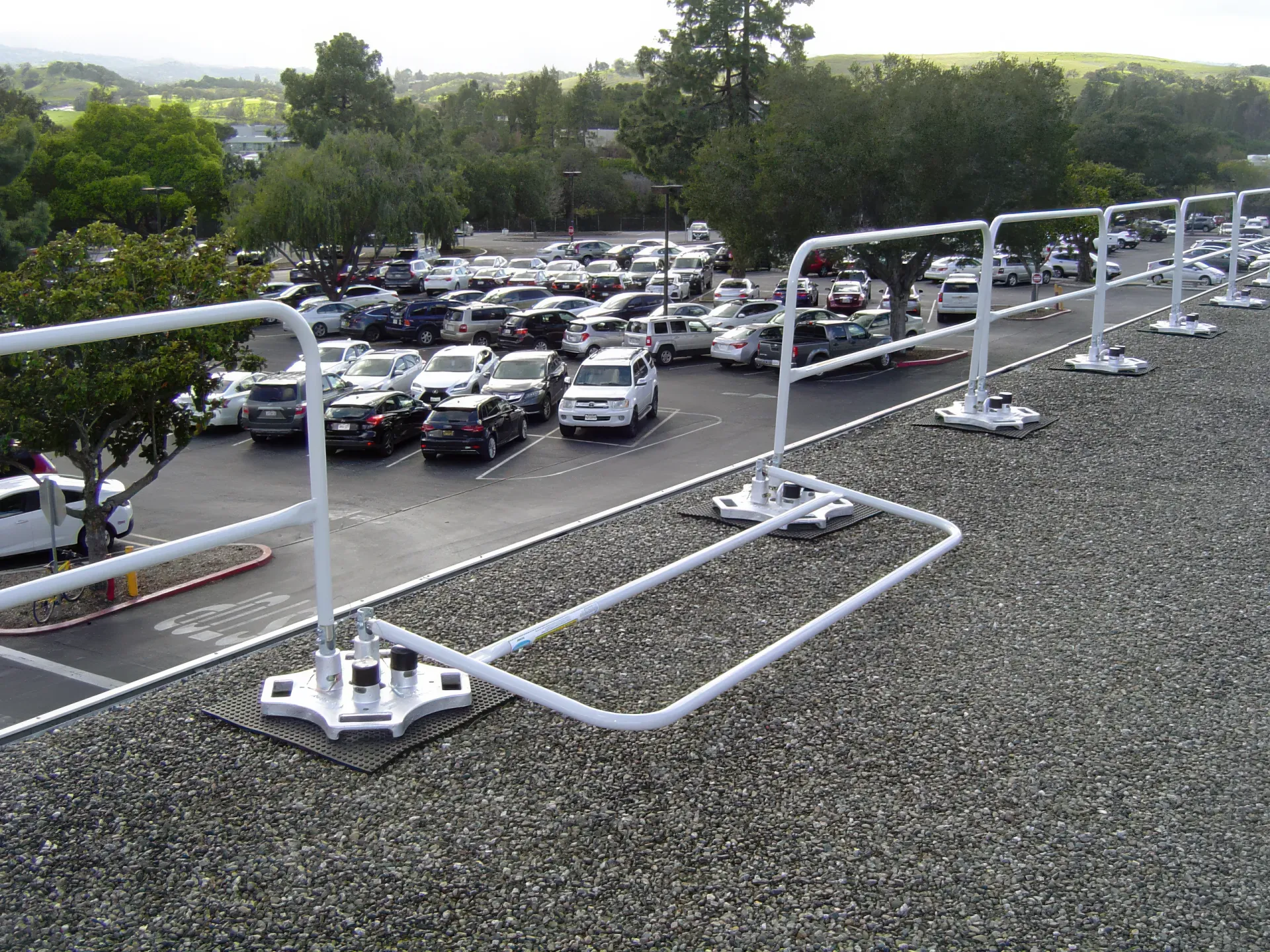

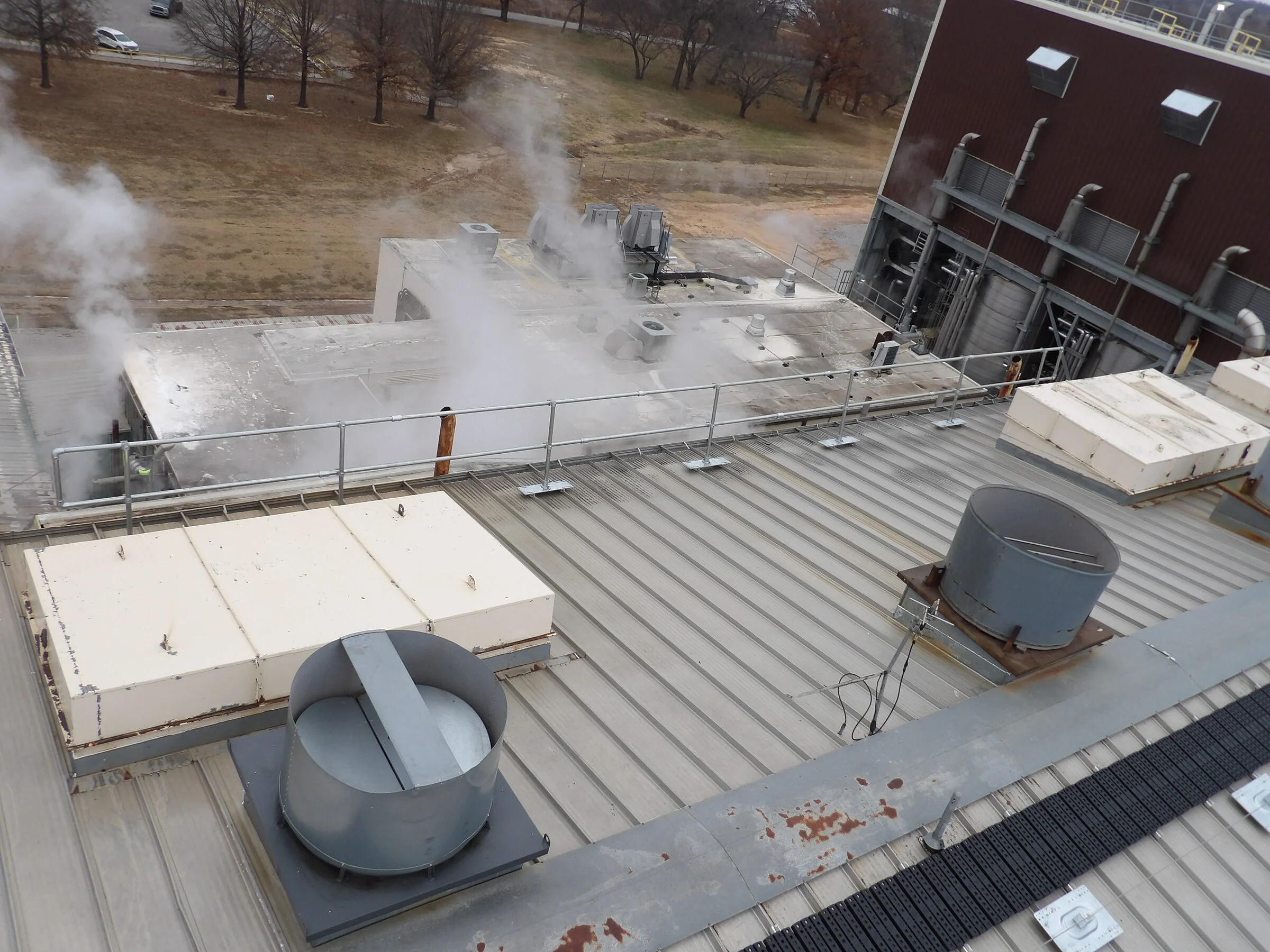
Freestanding non-penetrating roof guardrail on weighted bases along a gravel roof edge
Comparison
The short answer
Non-penetrating guardrail clamps to a parapet or sits on weighted bases, without drilling the roof membrane. Anchored guardrail is bolted into the parapet or the structure. Which one belongs on your roof depends on how the parapet is built, what the membrane and its warranty allow, the wind on the roof, and whether the system needs to stay in one place. Tritech designs, installs and certifies both, so the recommendation follows the roof you have, not a single product line.
The three approaches
There are three ways to hold a roof guardrail in place. Two of them are non-penetrating. One is anchored. The right choice is the one whose load path matches the parapet and the roof in front of you.
- Anchored, top-mount or side-mount. The posts are fastened into the parapet or the structure behind it. The load goes into the wall or the deck, so the connection and the waterproofing have to be designed together. This is the usual answer when the parapet can take the load and the system is meant to stay.
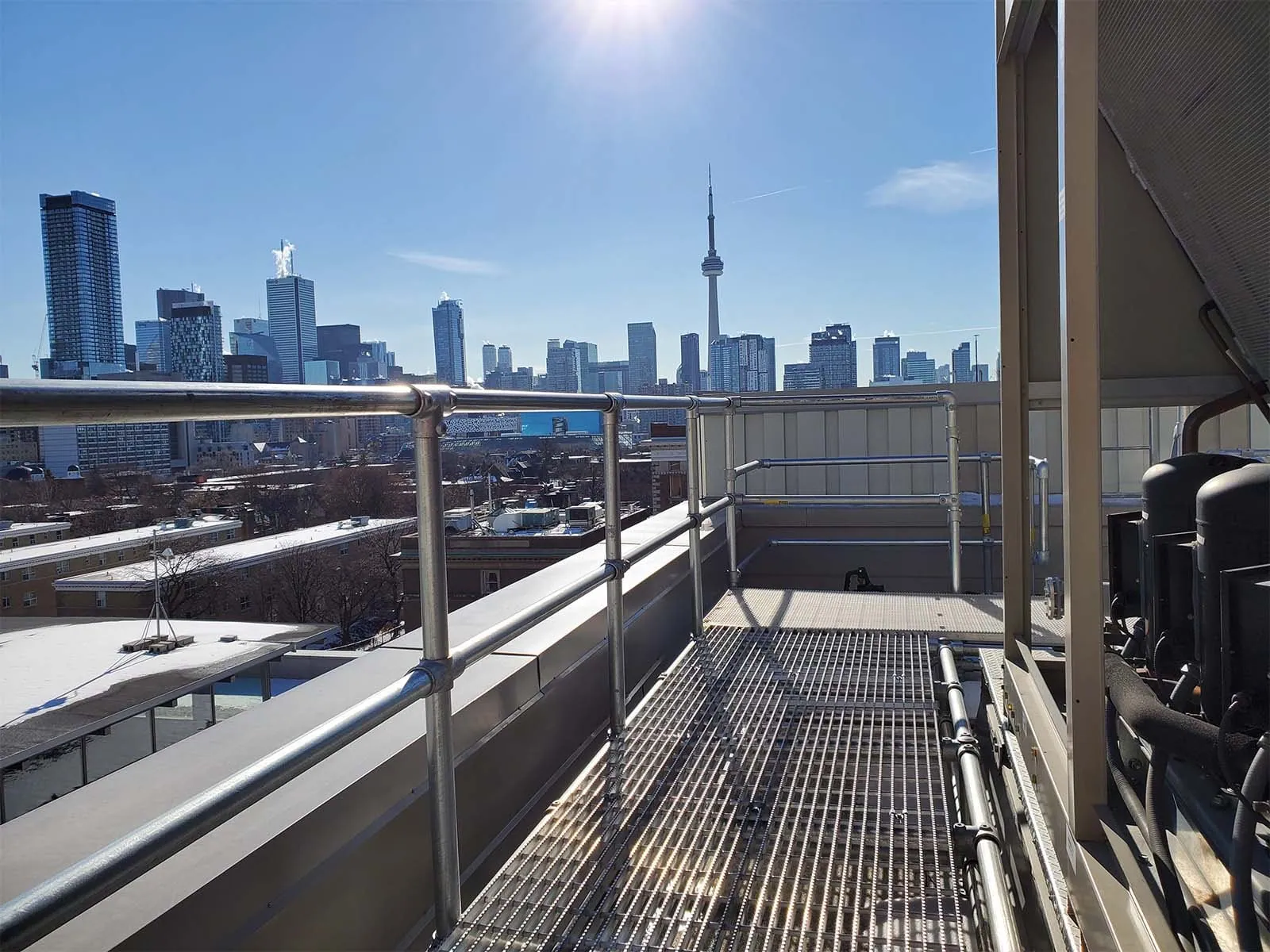
- Parapet clamp. A clamp grips the parapet instead of drilling the roof membrane. It only works when the parapet is wide enough, in good condition, and has a coping the clamp can hold. We measure that on the roof. A clamp that fits one wall will not necessarily fit the next.
- Freestanding, ballasted or counterweighted. The rail stands on weighted bases set back from the edge, so it does not rely on the parapet at all. Base size, spacing and ballast are part of the design, especially for wind. This is the usual answer when there is no usable parapet, or the membrane warranty rules out penetrations.
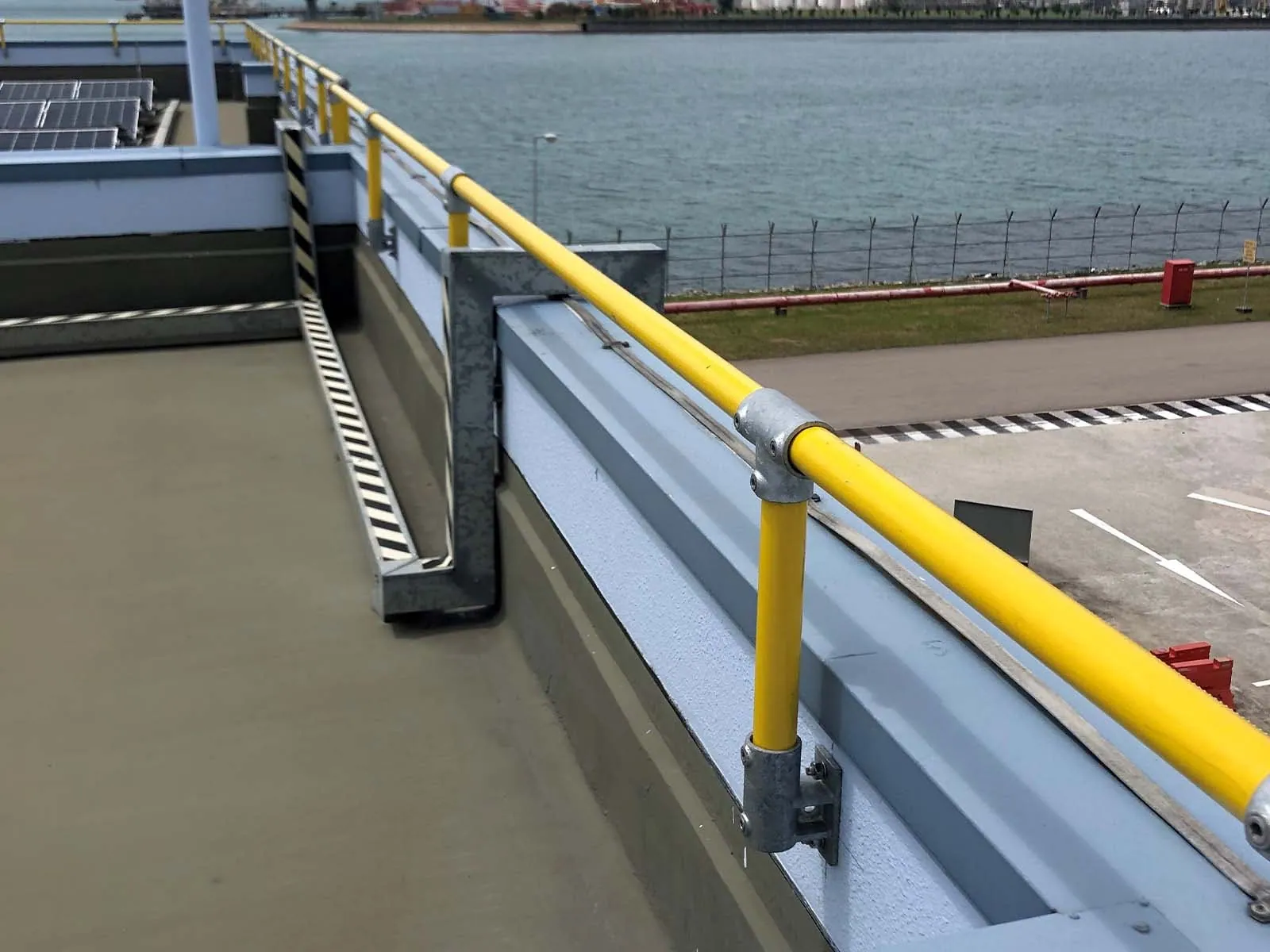
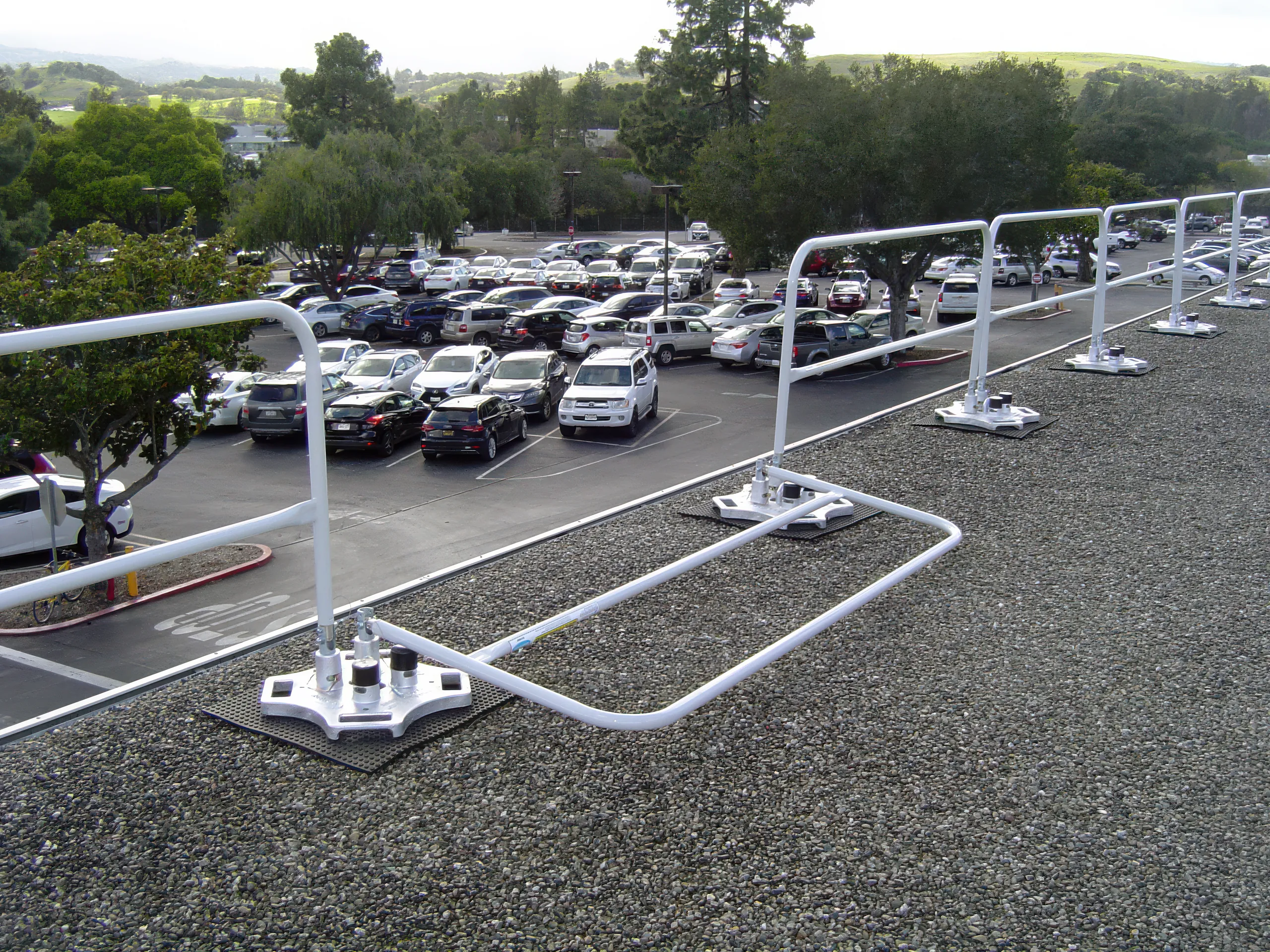
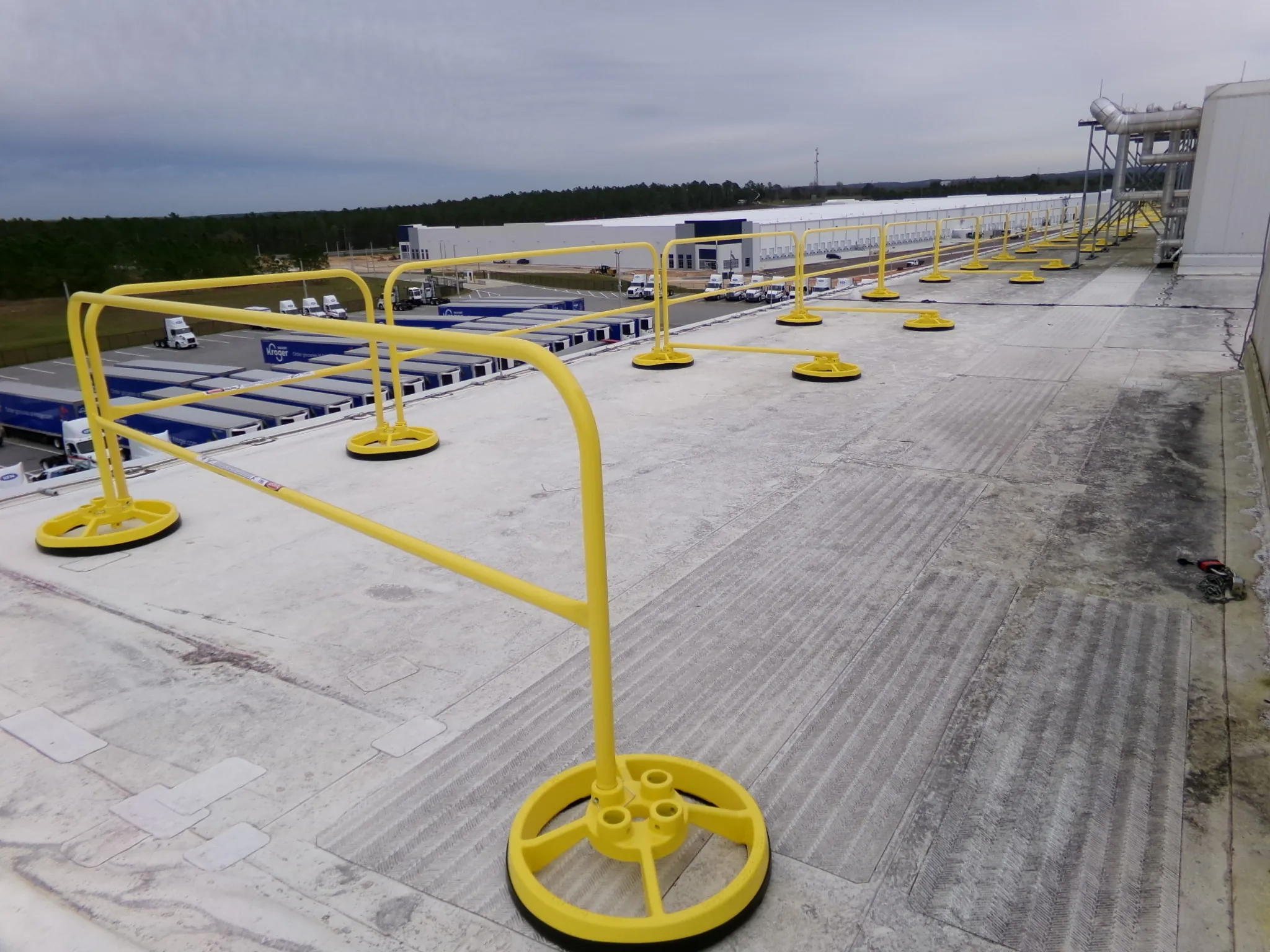
Click any photo to enlarge
See parapet guardrail for rails that extend a short wall, and non-penetrating roof guardrail for clamp-on and ballasted systems. The wider set of options is on our roof guardrail systems page.
Side by side
| Factor | Anchored | Parapet clamp | Freestanding / ballasted |
|---|---|---|---|
| How it attaches | Bolted or anchored into the parapet or structure | Clamps to the parapet without drilling the membrane | Sits on weighted or counterweighted bases |
| Roof membrane | The connection and flashing are designed to stay watertight | No membrane penetration if the clamp is on the parapet | No membrane penetration; bases and pads sit on the roof |
| Roofing warranty | Needs a designed, documented penetration or curb detail | Often acceptable when the parapet itself is used | Often the first choice when the warranty limits penetrations |
| Parapet | Needs a verified wall that can carry the load | Needs a sound parapet of usable width and coping | Does not rely on the parapet; set back from the edge |
| Load path | Into the structure at each post | Into the parapet through the clamp | Into the bases, the ballast and friction on the roof |
| Wind and seismic | Designed into the connection and the structure | Designed into the clamp and the parapet | Designed into ballast, base size and spacing |
| Permanence | Fixed in place | Can be repositioned if the parapet still suits a clamp | Can be moved or phased as the roof or the work changes |
| Setback from the edge | At the parapet or the designed line | At the parapet | Set back far enough for the bases and the required layout |
| What we inspect | Anchors, flashing, posts, rails and hardware | Clamp fit, parapet condition, posts, rails and hardware | Bases, ballast, pads, spacing, posts, rails and hardware |
| Relative cost drivers | Structure work, flashing and access to make the connection | Parapet preparation and clamp fit, when the wall qualifies | Base count, ballast and the area the layout occupies |
None of these rows is a price. The cost of a system follows the roof: how much structure or ballast it needs, how the membrane is protected, and how the rail is reached for install and inspection. We will tell you which approach fits before anyone fabricates a post.
Wind, warranty language and parapet width limits are site-specific. The table describes the decision, not a single width or wind speed that fits every roof. Those values are set in the design after we measure your parapet and review the membrane and the exposure with you.
When anchored is the better answer
Specify an anchored parapet guardrail when one or more of these is true:
- The parapet is solid and has been checked, and it can carry a designed connection.
- The rail has to stay in one place for the life of the roof.
- The extension above the parapet is tall, or the layout puts a high load on the posts.
- Wind or seismic demand on the site is better handled by a structural connection than by ballast.
- A clamp would not have enough sound parapet to grip, or the coping will not accept a clamp.
A weak or deteriorated parapet is not a reason to force an anchor into it. If the wall cannot take the load, we use a freestanding rail set back from the edge, or we design a connection into structure that can. That decision starts with when a parapet can be used as a guardrail and with a walk of the actual wall, not the finish you see from the ground.
Click any photo to enlarge
When non-penetrating is the better answer
Specify non-penetrating roof guardrail when one or more of these is true:
- The parapet is sound, within a clamp’s usable range, and the coping can hold a clamp.
- The roofing warranty, or the roofing manufacturer, limits or forbids membrane penetrations.
- The building is leased, or you do not control future roof work, and a system that can be moved is a better fit.
- The work is phased: one roof area now, another later, or a temporary edge during a project.
- There is no parapet, or the parapet cannot carry a rail, and a ballasted layout will fit the edge.
Non-penetrating is not an automatic yes. A clamp on a thin, hollow or crumbling parapet is the wrong system. A ballasted rail that cannot be set back far enough, or that cannot be designed for the wind on that roof, is also the wrong system. We will say so.
Click any photo to enlarge
Parapet clamps: guardrail clamps vs fall-arrest anchor clamps
The phrase “parapet clamp” is used for two different products, and they are not interchangeable.
A guardrail parapet clamp holds a rail post to the wall so the rail can serve as a barrier. Its job is to keep people on the roof. The load path, the width it can grip, and the way it treats the coping are all part of a guardrail design.
A fall-arrest anchor clamp is a tie-off point. A worker connects a lanyard or a self-retracting device to it. It is not a guardrail, and a guardrail clamp is not a substitute for a designed anchor. If your work needs a tie-off, that is a different system: see non-penetrating roof anchors and weighted anchor systems.
If you are searching for a parapet wall clamp, tell us whether you need a rail along the edge or a point to tie off to. We will not sell you the one that does not match the work.
Membrane questions: TPO, PVC, EPDM and modified bitumen
Most low-slope roofs we work on are TPO, PVC, EPDM or modified bitumen. Each one behaves a little differently under a base pad, and each roofing manufacturer writes warranty rules in its own way.
For a freestanding system, the questions are practical: will the bases sit on a pad that protects the membrane, will they slip or walk under wind or foot traffic, and does the roofing warranty allow a system that rests on the surface? For a clamp, the membrane question is smaller, but the parapet flashing and coping still have to stay watertight.
We review the membrane type and the warranty with you, and with your roofer when that helps, before the layout is finished. The aim is a rail that protects people without opening a leak or voiding a roof warranty you still need.
What “non-penetrating” does not mean: no engineering
Non-penetrating does not mean “no engineering.” A ballasted rail that looks simple from the parking lot still has to resist wind, stay in place, and meet the same guardrail criteria as an anchored rail. Base size, ballast, spacing and setback are calculated for that roof, not copied from a catalog page.
A clamp-on rail has the same duty. The parapet has to be strong enough, wide enough and sound enough to carry the load the clamp puts into it. We check that on site, including the structure behind the finish, before we call a clamp the right answer.
A rail that is easy to set down and hard to trust in a storm is not protection. That is why we measure the parapet, review the membrane, and calculate the layout before anyone walks beside it. Every system protects someone who is going home tonight.
How we decide on your roof
- We walk the roof with the people who use it. We look at the edges they actually walk, the hatches they use, and the equipment they service, not only the plan.
- We measure the parapet twice. Height from the walking surface, width, coping, and the construction behind the finish, at every level change.
- We review the membrane and the warranty. TPO, PVC, EPDM or modified bitumen, and what the roofer and the manufacturer will allow.
- We design either system. Anchored, clamp-on or ballasted, with PE-stamped drawings your team reviews before we fabricate.
- We install, certify, train and come back. Our own crew installs the rail, we keep you posted as the work moves, we certify it at handover, we train your people, and we return for inspection and recertification.
That process is the same whether the job is one roof in Orlando or a set of sites in both countries. Start with a fall hazard assessment if you want the edges documented first, or see fall protection services from design to yearly inspection.
Not sure which guardrail fits your roof?
Tell us about the parapet and the membrane. We will walk the roof with you, check the structure, and recommend an anchored rail, a clamp-on rail, or a freestanding ballasted system, with PE-stamped drawings.
Speak to a Fall Protection SpecialistAnswers to key questions
What is the difference between anchored and non-penetrating guardrail?
Anchored guardrail is fastened into the parapet or the structure. Non-penetrating guardrail either clamps to the parapet or stands on weighted bases, without drilling the roof membrane. Tritech engineers both and chooses from the parapet, the membrane, the wind and how permanent the system needs to be.
What is a parapet clamp, and is it the same as a fall-arrest anchor clamp?
No. A guardrail parapet clamp holds a rail post to the wall so the rail can work as a barrier. A fall-arrest anchor clamp is a tie-off point for a lanyard or a self-retracting device. They are different systems and are not substitutes for each other.
Can non-penetrating guardrail be used on a TPO or PVC roof?
Often yes, when the bases or clamps are detailed for that membrane and the roofing warranty allows it. We review the membrane type, the pads or coping, and the warranty with you before the layout is finished.
Does a non-penetrating guardrail still need to be engineered?
Yes. Ballast, base spacing, setback and wind, or the clamp and the parapet that holds it, still have to be designed for your roof. Non-penetrating describes the attachment, not the absence of engineering. Each system is issued with PE-stamped drawings.
Can a non-penetrating roof guardrail meet OSHA guardrail requirements?
A non-penetrating rail has to meet the same guardrail criteria as an anchored rail: the height and strength required for the work on that roof. The attachment method does not relax those criteria. Tritech designs each system to the applicable OSHA guardrail rules for the site, with PE-stamped drawings for engineered systems. The height and load figures are summarized on our roof guardrail systems page and in the parapet guide.
When is anchored guardrail the better choice?
When the parapet or structure can take a designed connection, when the rail should stay fixed, when the extension or the load is high, or when a clamp or a ballasted layout will not fit the wall or the edge. The comparison above walks through those cases.
Is non-penetrating guardrail only for temporary work?
No. A clamp-on or ballasted rail can be a permanent system when it is designed for the roof. The advantage is that it can also be moved or phased if the roof or the work changes. Permanence is a design choice, not a property of the attachment alone.

