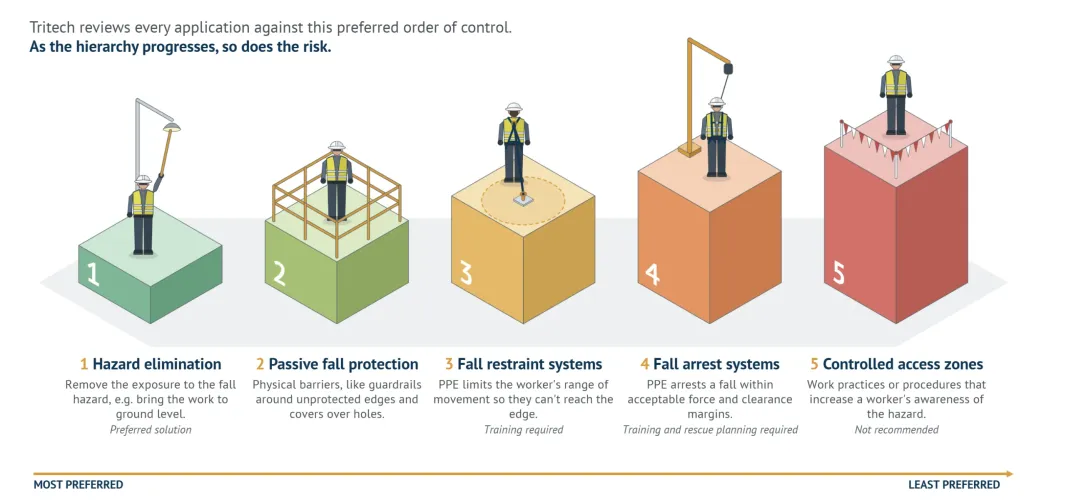
The preferred order of control
A contractor, not a catalog
The decision you are actually making
Buying a part number does not account for your beams, your clearance, or how many people will be tied off. A system that looks complete on paper can still come up short in a fall.
The questions that matter are whether the system will stop a fall before a worker hits the structure below, and whether the drawing set will stand up when corporate, insurance, or an inspector asks for the drawings.
- Will the system fit the structure that is already there?
- Will it arrest a fall in the clearance you actually have?
- Who stamps the drawings?
- Who installs it, certifies it, and comes back next year?
If those answers are not clear, you do not have a system yet. You have equipment.
What a Tritech project includes
A typical project is one scope, not a handoff between a designer, a fabricator, and a separate installer. It includes:
- A site assessment of the work and the structure
- A design sealed by a licensed Professional Engineer
- Installation by Tritech’s own crew
- Certification at handover, with user training and the operations and maintenance manual
- Annual inspection and recertification by the same team
See Our Process for each step, and inspection and recertification for what happens after install day.

Proof from a recent project
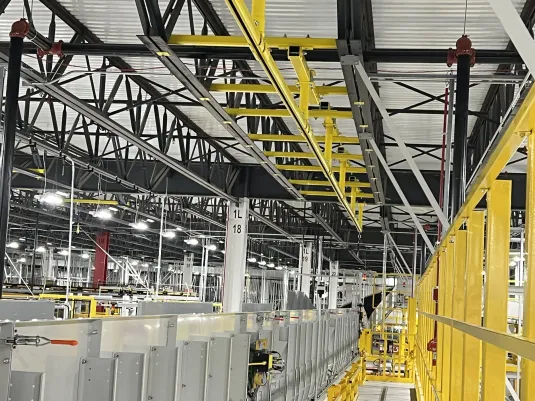
On a heavy equipment service bay in Alberta, we hung a 44 ft rigid rail from the girder of an existing 6.3 tonne overhead crane, so the anchor point travels with the work.
The rail is rated for two users. The drawings were sealed, the system was certified, and the users were trained before handover in two days. Read the crane-mounted rigid rail case study.
- 44 ft rigid rail hung from an existing 6.3 tonne crane
- Rated for two users
- Sealed drawings, certified at installation, handed over in two days
One process, every site
Engineered to your structure
The system is designed for the beams, clearances, and work already on your site, including curves, existing cranes, and tight overhead obstructions. A licensed engineer seals the drawings so the people who have to sign off can review them.

Installed and certified by one team
The same contractor that designed the system installs it, certifies it at handover, and trains the people who will use it. You are not left coordinating a catalog vendor and a separate installer.
The same process across the US and Canada
EHS leaders who run more than one site get one process, one drawing standard, and one team to call. We engineer and install systems across the US and Canada, including rigid rail, horizontal and overhead lifelines, and rooftop fall protection.
-
What do fall protection services include?
A typical Tritech project includes a site assessment, a design for the structure and the work, sealed engineering drawings, installation, certification at handover, user training, and the operations and maintenance manual. The same team returns for annual inspection and recertification.
-
How is this different from buying a system from a catalog?
A catalog part is designed for a generic use. An engineered system is designed for your structure, your clearance, and the number of people who will be tied off. Tritech owns that work from the first assessment through certification and annual recertification, so there is not a gap between the product, the drawings, and the installer.
-
Do you work on systems another contractor installed?
Yes. We inspect and recertify systems we did not originally install, and we can assess a site and design a new system where the current protection is not adequate. If you already have a drawing set, we review it as part of the work.
-
Can you use the same process at more than one site?
Yes. The process is the same on every site: assess, engineer, seal the drawings, install, certify, and recertify. That is how we work with safety teams that manage facilities across the US and Canada.
-
What happens after the system is installed?
At handover you get certification, user training, and the operations and maintenance manual. After install day, the same team returns for annual inspection and recertification so the system stays in service. See inspection and recertification.