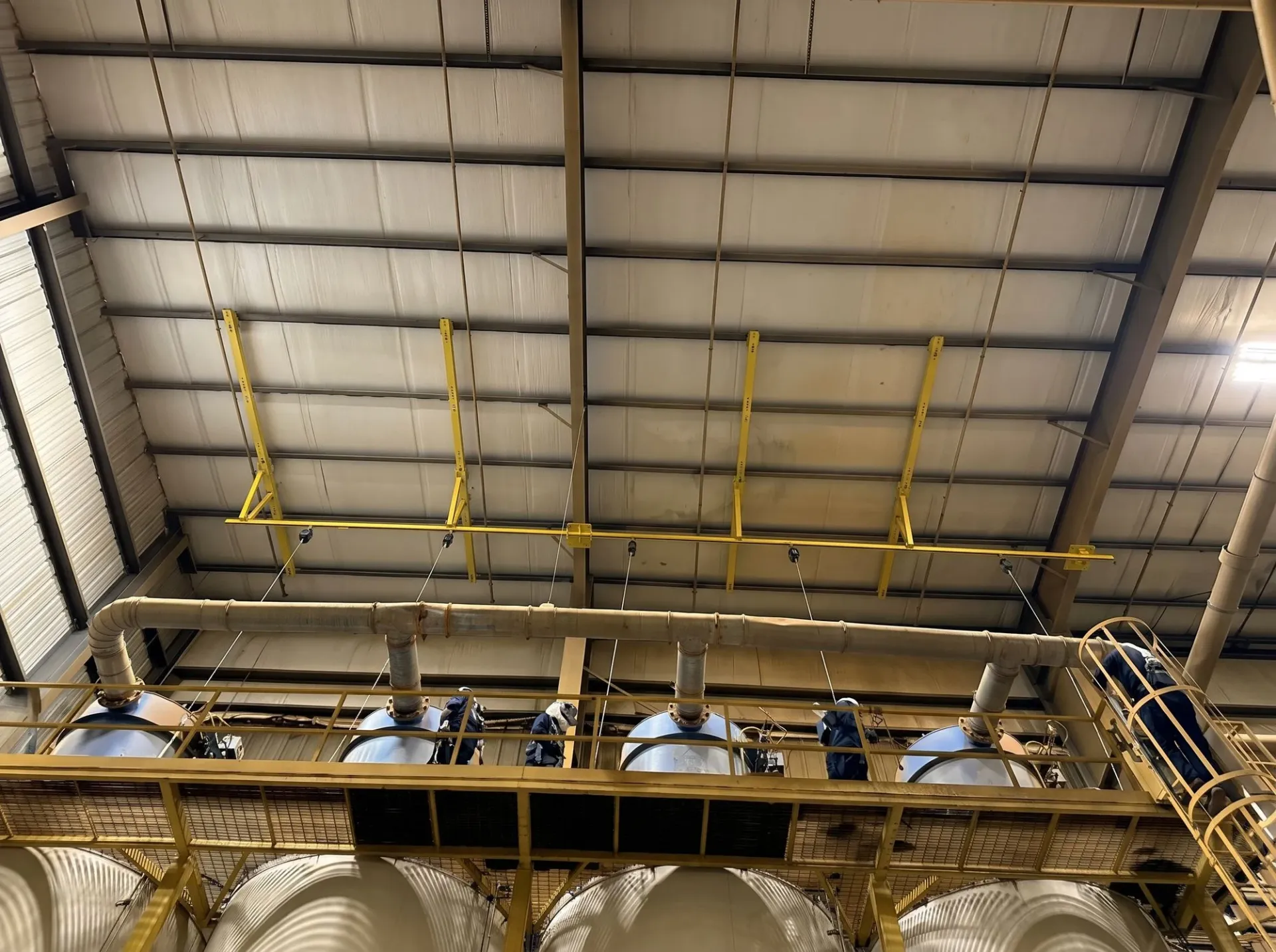
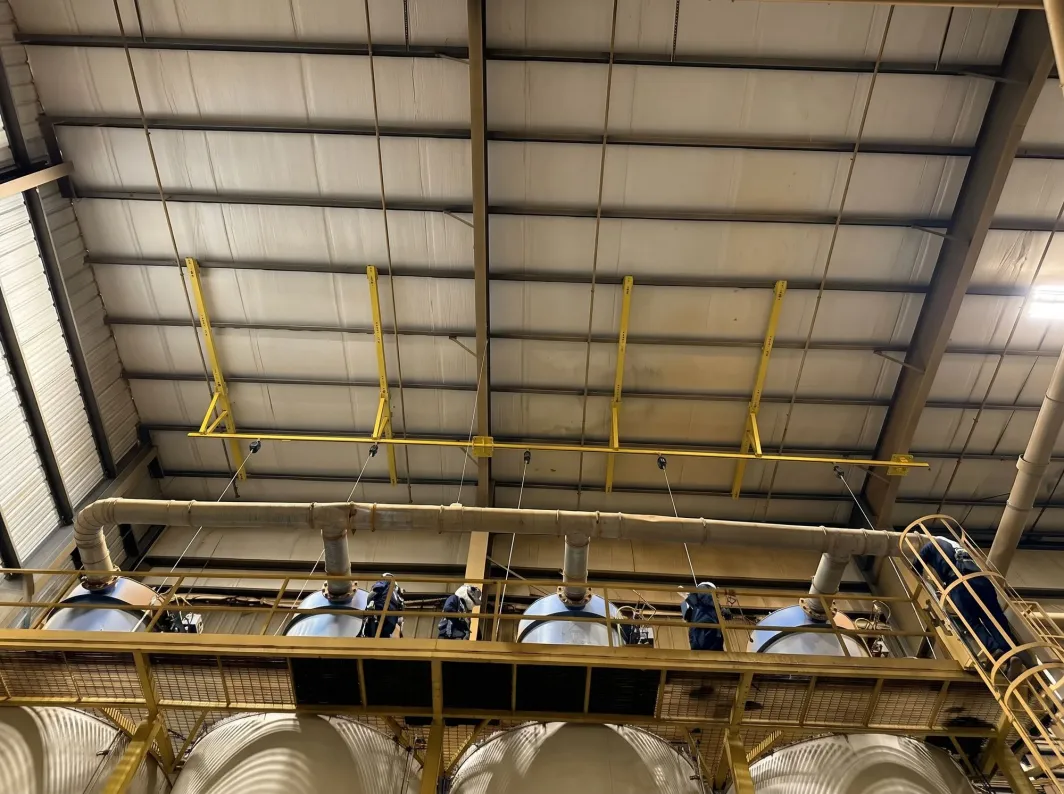
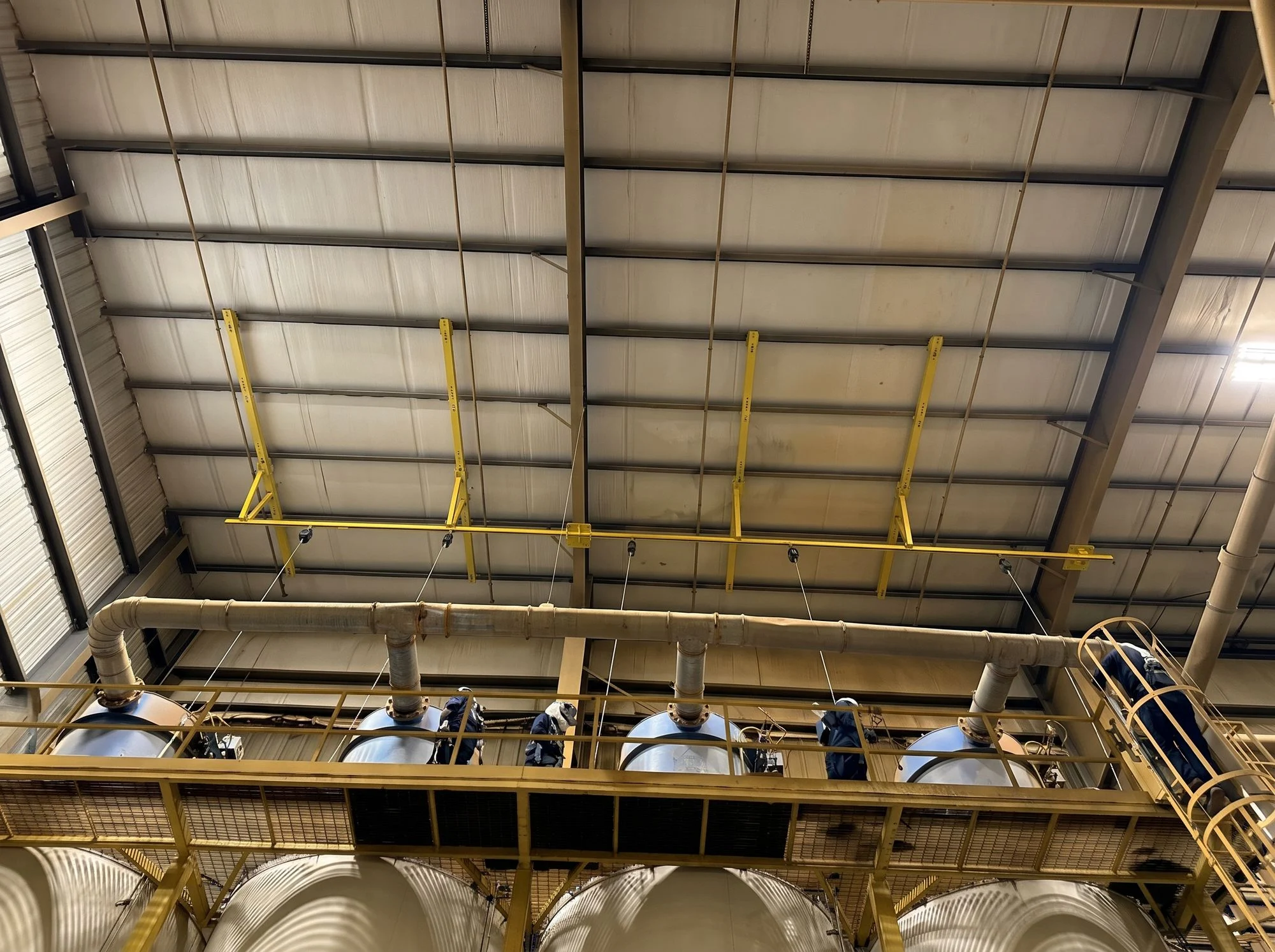
Overhead rigid rail with self-retracting lifelines above an elevated tank deck
Comparison
The short answer
Choose rigid rail when the clearance below the worker is tight, the work is overhead, or several people work close together. Choose a cable horizontal lifeline when the run is long and there is room below for the line to deflect. Tritech designs, installs and certifies both, so the recommendation follows your site, not a product line.
The difference in one minute
Both systems give a worker a connection point that travels with them. The difference is what happens in a fall.
A rigid rail is a fixed structural track. A trolley rides along it, and the track barely deflects under load, so it arrests a fall in a short distance and keeps the connection point high. A cable lifeline is a tensioned wire rope between anchors. It stretches and sags when it catches a fall, so the worker drops farther before they stop.
That extra distance is the whole decision. A fall has to stop before the worker reaches the level below: the floor, a truck deck, a tank top, or the roof of a railcar. Where there is room below, a cable lifeline does the job over a long run. Where there is not, rigid rail is the system that keeps the worker off the structure below.
Side by side
| Factor | Rigid rail | Cable horizontal lifeline |
|---|---|---|
| Behaviour in a fall | Barely deflects; arrests a fall in a short distance | Stretches and sags; the worker drops farther |
| Clearance needed below | Less | More |
| Span | Supported runs, including curves and tight layouts | Long runs between fewer supports |
| Mounting | Hung from beams, an existing crane, or freestanding supports | Anchored at the ends and at intermediate supports |
| Structure | Load goes into each support along the run | High loads at the end anchors in a fall |
| Several users | Engineered for multiple trolleys on one track | Set by the engineered design and manufacturer specifications; each added user increases sag and clearance. Intermediate supports can help control deflection. |
| Typical places | Loading racks, tanker bays, tank decks, crane bays, maintenance shops | Rooftops, long walkways, building edges, open structures |
| After install | Annual inspection and recertification | Annual inspection and recertification |
The right answer comes from the numbers for your site: how far a worker can fall before they hit something, how many people tie off at once, and what the structure can carry. We calculate the fall clearance for each working position and show it in the drawings.
When rigid rail is the right call
Specify rigid rail lifeline systems when one or more of these is true:
- The worker stands close to the level below, such as a truck deck, tank top, or low platform.
- The work is overhead and the anchor needs to stay above the worker.
- Several people work close together on the same run.
- The run needs curves, or it has to follow an existing crane or beam line.
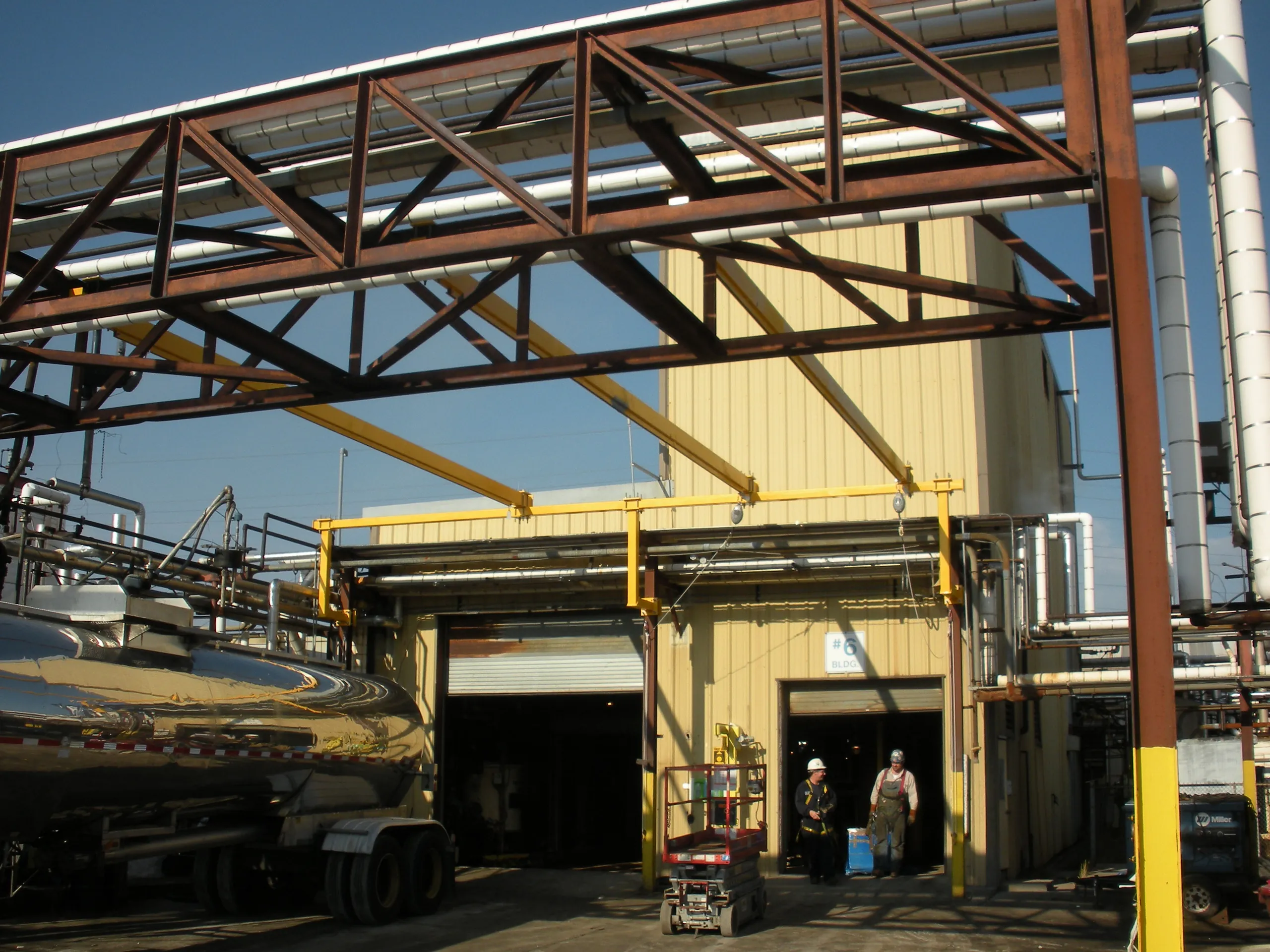
Click any photo to enlarge
Proof from a recent project. In a heavy equipment service bay in Alberta, we hung a 44 ft rigid rail from the girder of an existing 6.3 tonne overhead crane, so the anchor point travels with the work. It is rated for two users, holds total fall distance to 1 ft 11 in at minimum free fall, and was handed over with trained users in two days. Read the crane-mounted rigid rail case study.
When a cable lifeline is the right call
Specify horizontal lifeline systems when one or more of these is true:
- The run is long, such as a roof edge, a long walkway, or the length of a building.
- There is room below for the line to deflect before the worker reaches anything.
- The structure can take the end anchor loads, or anchors can be added.
- The number of people who can use the line at once is set by the engineered design and the manufacturer’s specifications. Each added user increases cable deflection in a fall; more intermediate supports can help control that deflection.
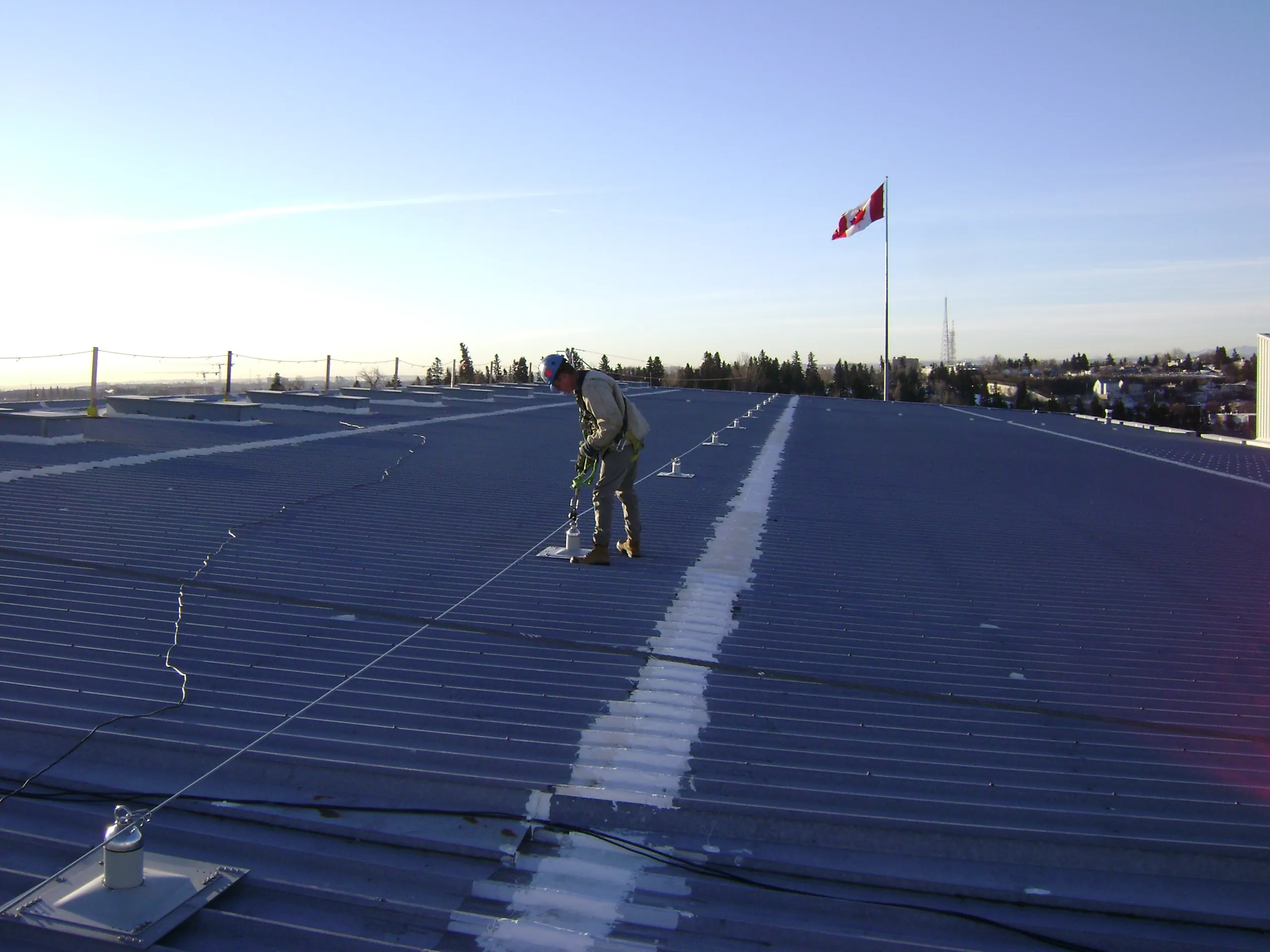
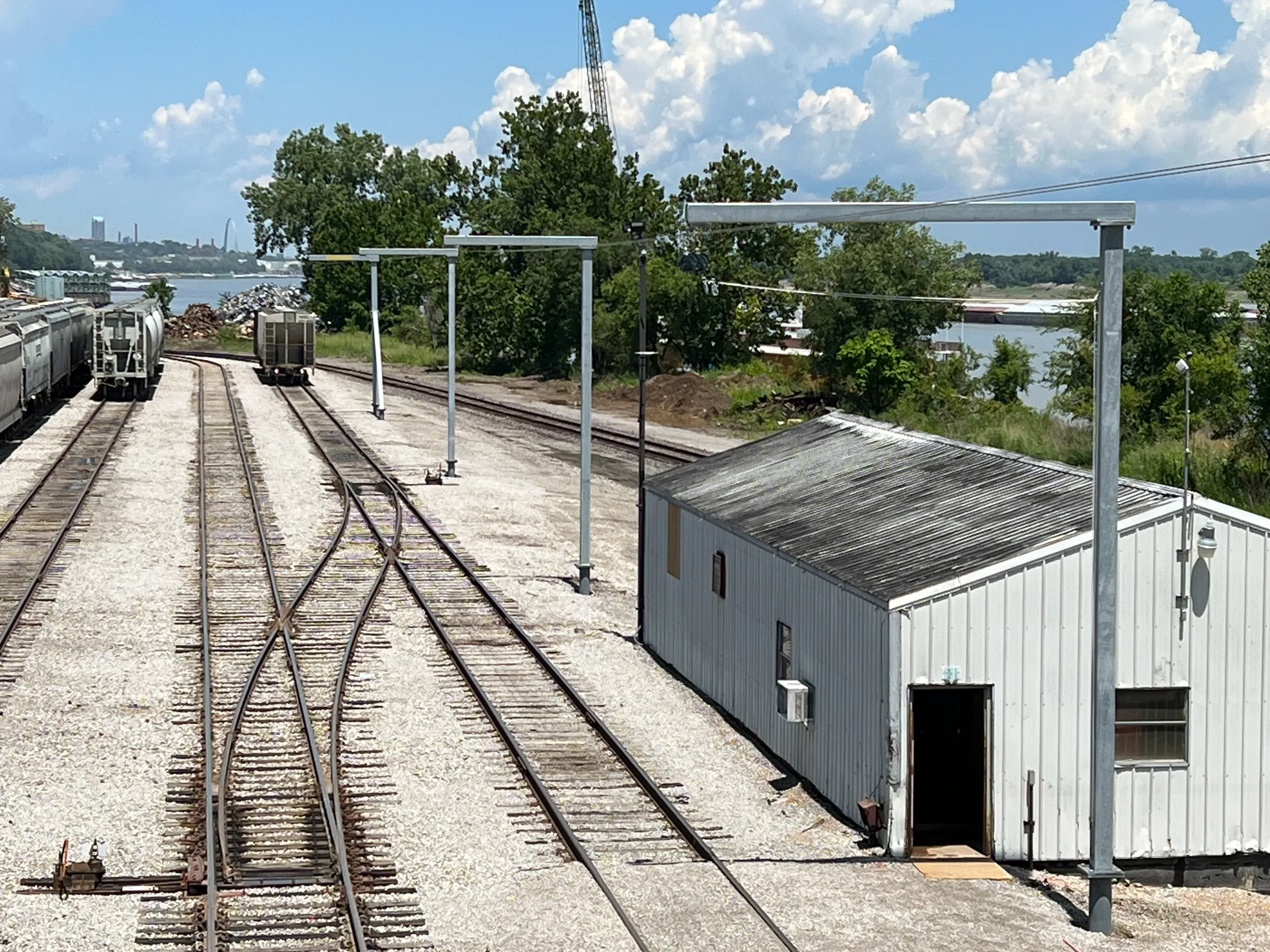
Click any photo to enlarge
Cable lifelines also run overhead where clearance allows. See overhead lifeline systems.
When it could go either way
Some sites sit in the middle: a long loading rack with good clearance at one end and a low truck deck at the other, or a roof where most of the edge is open but one area sits over equipment. In those cases we run the fall clearance at each position and compare the structure, the number of users, and how the work is done. It is common to use both systems on one site, each where it fits.
We will tell you plainly when a cable lifeline will do the job. We would rather do that than sell you a rail you do not need.
How we decide on your site
- We walk the site with the people who do the work. We watch the task, not just the drawing.
- We measure every working position twice. Clearance below, the structure above, and how many people tie off at once.
- We design and calculate. The fall clearance goes into PE-stamped drawings, and your team reviews them before we fabricate.
- We install and certify. Our own crew installs, we keep you updated as the work moves, and we certify the system at handover.
- We train and follow up. Your users are trained before we leave, and we return for annual inspection and recertification.
A lifeline that looks right on paper and stops a worker six inches too late is not a system. That is why we measure, calculate, and check our own work before anyone ties off. Every system protects someone who is going home tonight.
See fall protection services from design to recertification, or more case studies.
Not sure which system fits?
Tell us about the work area. We will walk it with your crew, run the fall clearance, and recommend rigid rail, a cable lifeline, or both, with PE-stamped drawings.
Speak to a Fall Protection SpecialistAnswers to key questions
What is the difference between rigid rail and a cable lifeline?
A rigid rail is a fixed structural track that barely deflects under load, so it arrests a fall in a short distance and keeps the connection point high. A cable lifeline is a tensioned wire rope that stretches and sags when it catches a fall. Rigid rail suits low-clearance and overhead work; a cable lifeline suits long runs with room below.
Which system needs less fall clearance?
Rigid rail, because the track barely deflects. A cable lifeline’s sag adds to the total fall distance, and each added user increases that deflection; more intermediate supports can help control it. How many people can use the line, and the exact clearance, are set by the engineered design and the manufacturer’s specifications, so Tritech calculates them for each working position.
Can a cable lifeline be used overhead?
Yes, where there is enough clearance below the worker for the line to deflect. Where clearance is tight, such as over a truck deck or tank top, rigid rail is usually the better choice.
Can a rigid rail be curved or mounted to an existing crane?
Yes, when the structure and the new load path are engineered for it. Rigid rail can follow curves and tight layouts. In Alberta, we hung a 44 ft rigid rail from an existing 6.3 tonne overhead crane so the anchor point travels with the work.
Do both systems need to be engineered?
Yes. Each system is designed for the structure, the number of users and the fall clearance, with drawings sealed by a licensed Professional Engineer. Tritech designs, installs and certifies both, so one team owns the result.
How often do rigid rail and cable lifelines need inspection?
Plan on at least an annual inspection and recertification, plus the checks before each use that the equipment manufacturer requires. Tritech runs annual inspection programs for the systems it installs.

