Midland · Odessa · Permian Basin
Engineered fall protection systems in Midland & Odessa
Designed, PE-stamped and installed by one team.
Tritech helps industrial, energy and commercial facilities across Midland, Odessa and the greater Permian Basin put permanent fall protection where crews actually work: rooftop guardrail, horizontal lifelines, overhead rigid rail and ladder safety systems, each engineered for the structure or the processing equipment it sits on. Talk with Wes Hopkins about your facility, a capital project that is coming up, or a system that is already there and needs to be brought back into compliance.
- PE-stamped designs
- Design, fabrication and installation
- Serving Midland, Ector and the Permian counties
- Since 1993 turnkey fall protection
- PE-stamped designs
- Design, fabrication and installation
- Serving Midland, Ector and the Permian counties
- Since 1993 turnkey fall protection
Trusted by industry leaders for truly turnkey systems

Why facilities call
Three reasons a West Texas facility calls us.

Your HVAC technicians, fluid-handling crews or process maintenance contractors have flagged an unprotected edge, a pipe rack or an elevated tank top before a scheduled job. Start with where the work is, how people get up there and what they carry — the system should fit how the site is actually worked, not a generic perimeter line.
An internal safety audit, a corporate EHS team, an insurer or a federal OSHA inspection has identified an exposed roof perimeter, an open hatch, an unguarded skylight or a caged fixed ladder that no longer complies. Send us the findings, the hazard log and any deadline, and the site walk goes straight at the items that were cited.
There are cables, stanchions or anchor points on the roof, the loading gantry or the pipe rack, but the stamped calculations, serial numbers or inspection records are missing. We review the structure, proof-test what can be tested and recertify under OSHA 1910 and ANSI Z359, so the paper trail is complete.
What we install
Permanent systems for roofs, pipe racks and elevated industrial equipment.
Everything below is engineered to your structure, fabricated, installed by Tritech crews and documented with stamped drawings. Nothing portable, nothing rented. Each card leads to the full system page.

Industrial and rooftop guardrail
Collective edge protection that takes harness training and inspection logs out of the routine. Non-penetrating weighted bases for single-ply membranes, clamp-on rails for standing-seam metal buildings and parapet-mounted railings, designed to the 200 lb loading of OSHA 1910.29 and the wind the Permian Basin throws at a roof.
Explore guardrail and barrier systems →
Horizontal lifeline systems
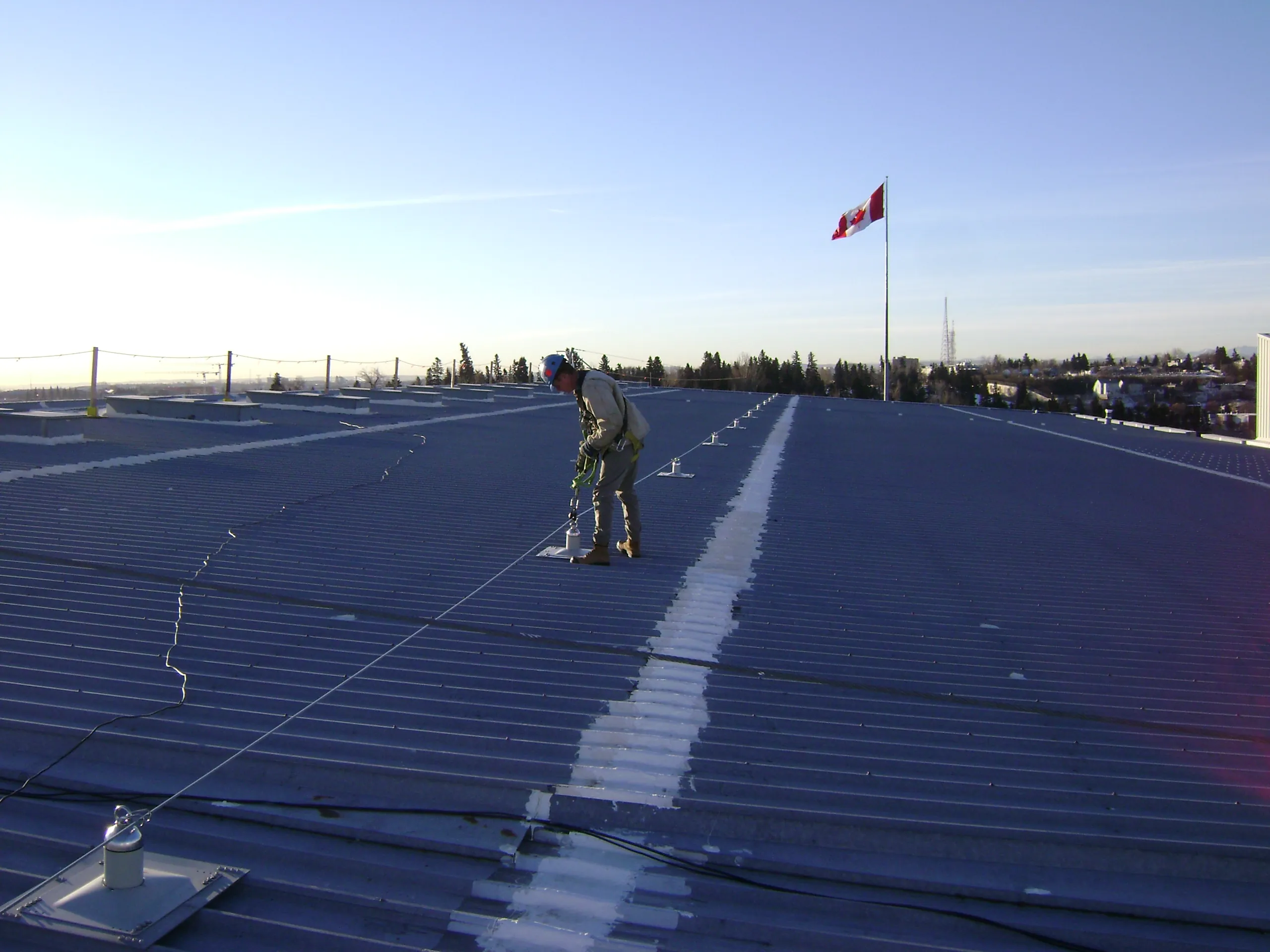
Continuous tie-off along high-bay roofs, elevated catwalks and pipe racks. Single- and multi-span cable systems with inline energy absorbers, designed for restraint or arrest, with clearance, structural load and rescue staging worked out before anything is fabricated.
Explore horizontal lifeline systems → Rigid rail and overhead fall arrest
Zero-deflection overhead arrest for frac sand terminals, maintenance shops and pump bays, where cable sag would put a falling worker into the equipment below. Enclosed track for railcar and truck loading, pump skids and crane runways.
Explore rigid rail systems →-
Ladder safety and roof hatch protection
Caged fixed ladders retrofitted or replaced with a ladder safety system under OSHA 1910.28, with self-closing gates at the hatch and the platform.
-
Skylight and roof-opening screens
Clamp-on, non-penetrating screens and guardrail for the skylights and openings on metal and membrane industrial roofs — the fall-through hazard the edge system does not cover.
-
Crossover stairs and maintenance gangways
Modular aluminum and galvanized platforms over piping, conduit and equipment runs, so the route to the work is as protected as the work area.
-
Annual recertification and pull testing
Visual inspection, component replacement and load testing for fall arrest systems of any make, with the records your safety file needs.
Midland–Odessa facility needs
The industrial environments we see most across West Texas.
Between Interstate 20, Highway 191 and the industrial corridors of Midland and Ector counties, the same conditions shape every design: dust and grit, high ambient heat, sustained wind loading and corrosive atmospheres around oilfield processing. The facilities come in three broad kinds.
-
Oilfield equipment manufacturing, machine shops and fabrication yards
Pre-engineered metal buildings housing CNC machines, overhead bridge cranes and high-bay service areas. These usually need clamp-on standing-seam roof guardrail, crane-runway lifelines or overhead rigid rail that anchors to the building frame without getting in the way of production.
-
Bulk terminals, frac sand depots and railcar facilities
Multi-bay truck and rail loading stations where people walk on tanker domes, hopper cars and the tops of storage silos. Low-clearance overhead rigid track, drop-down gangways and davit systems designed so the worker moves fast and stays tied off.
-
Midstream compressor stations, processing plants and warehouses
Distribution centers, processing complexes and cold storage along the I-20 corridor. Non-penetrating rooftop perimeter guardrail, service corridors to the rooftop units and pipe-rack crossovers that keep penetrations out of the roof and the insulated envelope.
Relevant Tritech projects
Industrial installations, engineered for high-risk sites.
Texas
Lifelines, single point anchors and counterbalanced gates at an industrial distribution facility
The project addressed leading-edge exposure at mezzanine loading gates worked from below by forklift, with several users on shift work: tie-off where people must reach the edge, gates where a barrier fits, without slowing the loading.
Read the case study →Florida
Fall protection across manufacturing, aerospace and defense sites
The project addressed work at height on process equipment, mezzanines, rooftops, loading docks and tanks: horizontal lifelines, rigid rail, guardrail and anchors matched to each hazard, specified for a corrosive climate.
Read the case study →Client names withheld at their request. Locations are shown by state; the Florida project is not a Permian Basin installation. See more in the project gallery →
From site assessment to installation
One accountable team from the first site walk to the final sign-off.
- 01
Understand the site and the work
Wes talks through the facility drawings, photographs, the specific tasks at height and any deadline, then walks the site to look at attachment points, access routes and where the operation cannot be interrupted.
- 02
Engineer the design
Our engineers model the structure, calculate the arrest loads, set the system geometry and produce the stamped drawings and calculation package.
- 03
Define the proposal
One lump-sum proposal covers design, fabrication, certified hardware, field installation and the handover documentation, with site requirements and exclusions spelled out.
- 04
Coordinate and install
Tritech's own crews do the installation, scheduled around your plant, shift turnarounds and the site safety orientation. Rooftop and high-exposure work is planned for the cooler hours and the day's wind.
- 05
Complete the handover
You get the stamped as-built drawings, the load calculations, the user guidelines and the compliance certificates for your safety records, and we agree how the system will be inspected and who keeps the file.
Questions about fall protection in Midland and Odessa
Answers before the first call.
Anything not covered here, Wes answers on the phone.
Do you handle both the engineering and the installation in Texas?
Yes. Tritech designs, fabricates and installs as one team, and the drawings are PE-stamped. Your proposal names the engineering deliverables, the installation scope and the handover documentation, so there is no outside consultant to hire and no gap between the engineer who designed the system and the crew that installed it.
What does OSHA require on industrial facilities and low-slope roofs in Texas?
Texas private-sector workplaces fall under federal OSHA, Region VI, headquartered in Dallas: 29 CFR 1910 for general industry and 29 CFR 1926 for construction. Under 1910.28, workers exposed to a fall of 4 ft or more must be protected. On a low-slope roof, work within 6 ft of the edge calls for guardrail, travel restraint or fall arrest; a designated area with warning lines from 6 to 15 ft applies only to work that is both infrequent and temporary. Review the actual task before choosing a system.
Can your systems stand up to West Texas wind, sand and corrosive environments?
Yes. Sustained wind, sudden gusts, sand abrasion and the chemical and H2S atmospheres around oilfield processing are part of the engineering review. Materials and finishes — hot-dip galvanized steel, stainless cable, powder-coated components — are specified for the exposure at your site, and non-penetrating weighted bases are checked for stability in the wind without voiding a standing-seam or low-slope roof warranty.
Should we use guardrail or a lifeline on a Permian Basin site?
Guardrail is a barrier: nobody needs a harness, training or an inspection log to be protected by it. Lifelines and rigid rail are active systems that depend on the user connecting and on the clearance below. Which one fits comes down to how often the work happens, who does it and what the structure can carry. The site assessment compares the suitable options side by side.
Can you inspect and recertify a system another contractor installed?
Usually, yes. We inspect, load-test and re-document existing systems across West Texas: the original drawings, the anchors, cable tension and hardware condition against OSHA 1910 and ANSI Z359. You get a stamped certificate where the system passes and a remediation scope where it does not.
How do you protect standing-seam and R-panel metal roofs without causing leaks?
With non-penetrating clamps engineered for your exact panel profile — trapezoidal, standing seam or batten cap. They grip the seam with torque-controlled friction and never puncture the panel, so the roof stays weather-tight and the warranty stays intact. Where a profile cannot be clamped, we design around it.
Can you install through the West Texas summer heat and high winds?
Yes. Our crews work West Texas conditions year-round. Rooftop and high-exposure work is scheduled for the early hours, and crane lifts, welding and anchoring are planned around the day’s wind so the installation stays safe and your production does not stop.
How does Texas enforce fixed-ladder compliance?
Under OSHA 1910.28(b)(9), cages on fixed ladders over 24 ft are being phased out. A ladder installed after November 19, 2018 must have a personal fall arrest system or a ladder safety system, and every existing caged ladder must be retrofitted or replaced with one by November 18, 2036. We convert cages to vertical lifeline cable or rigid-rail systems and add self-closing gates at the top.
More of our work
Photos from the field, and the full project write-ups.
The projects above are the ones closest to the territory. The rest of what Tritech has designed and installed lives in two places.
Project gallery
51 installation photos from Tritech sites, filterable by system, industry and application — guardrail, lifelines, rigid rail, platforms and anchors as they were actually built.
Browse the project gallery →Case studies
6 projects written up in full: the hazard, the options the engineers weighed, the system that went in and what changed for the people using the roof or the floor.
Read the case studies →Service area
Serving Midland, Odessa and the Permian Basin corridor.
- Midland County
- Midland, Greenwood, Spraberry
- Ector County
- Odessa, Goldsmith, Gardendale, Penwell
- Andrews and Martin counties
- Andrews, Stanton
- Howard and Glasscock counties
- Big Spring, Garden City
- Winkler, Ward and Reeves counties
- Kermit, Monahans, Pecos
- Extended coverage — Eddy and Lea counties, New Mexico
- Hobbs, Carlsbad
Private-sector workplaces in Texas fall under federal OSHA, Region VI, headquartered in Dallas. Whether you run one fabrication plant in Odessa or a network of compressor stations and warehouses across the Basin, you get the same engineering standard, the same stamps and one point of accountability. Include the facility city and ZIP code in your inquiry so Wes can confirm coverage; for several locations, list each site and the kind of work involved.
Request a site assessment
Let’s discuss your Midland–Odessa facility
Tell us where the facility is, the elevated work that needs protecting and your timeline. Three short steps. If you have roof or structural drawings, photographs or a previous inspection report, keep them handy for the call.
Prefer to talk? Call Wes directly — he answers his own phone during business hours.
Mon–Fri, 7:00–6:00 Central