Brochure
Rooftop Crossover Platforms Brochure
A modular, non-penetrating crossover that lets workers walk safely over pipes, ducts and height changes on the roof. Guardrails, non-slip treads and toe boards, designed to OSHA and ANSI standards.
What’s inside
- Why pipes, ducts and roof-level changes are trip-and-fall points
- A modular, non-penetrating stair-and-bridge over the obstruction
- Guardrail on both sides for the full path: stairs, bridge and landings
- System specs: 42-inch rail height, 200 lb load, flooring and base options
- Related platforms: rooftop walkways, static and mobile platforms, catwalks and gangways
- What OSHA requires: 4 feet in general industry, 6 feet in construction
Every pipe, duct and level change on a roof is a trip point
Workers still have to get past these obstacles. Without a safe crossing, people trip, fall, or step on the equipment below. A crossover gives them a clear, guarded path over the obstruction.
A modular system that does not pierce the roof
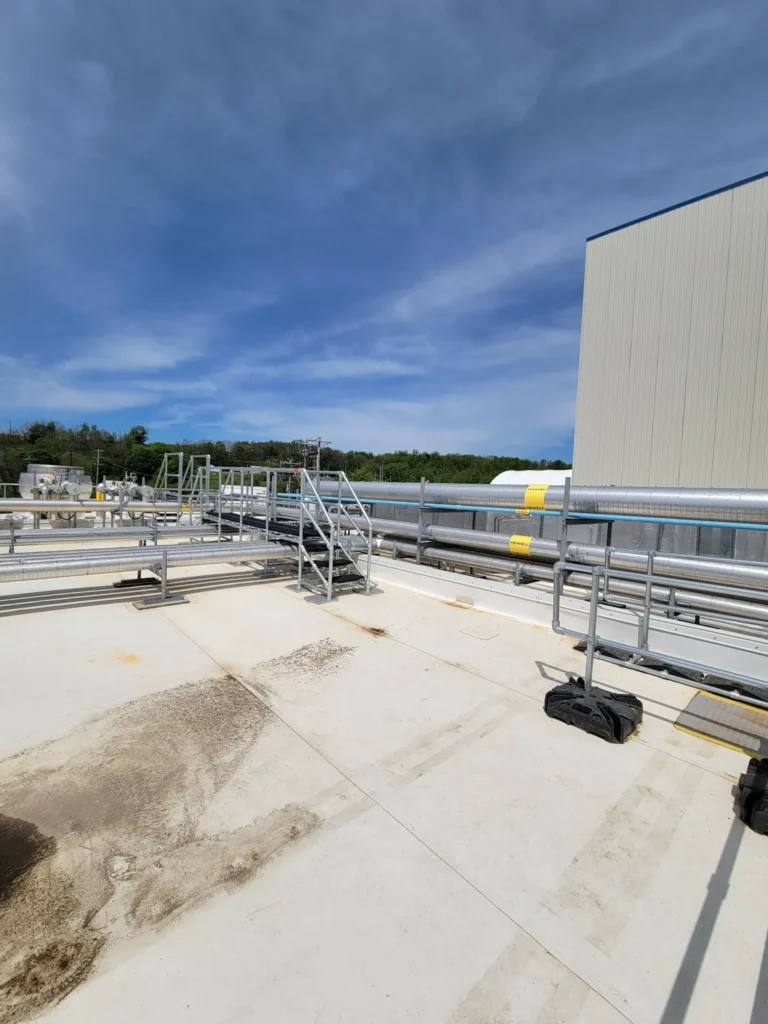
Tritech engineers each crossover to the pipe run, duct or change in roof level. Non-penetrating bases sit on the membrane unless a site condition requires a fixed foot. The stair, bridge and landings have guardrail on both sides, with non-slip treads and toe boards. Designed to OSHA and ANSI standards.
Key specs
| Top rail height | 42 in ± 3 in |
|---|---|
| Outward or downward force | 200 lb |
| Material | Aluminum or galvanized steel |
| Flooring | Nylon treads, checker plate or grating |
| Roof penetrations | None, unless site conditions require it |
| Installation | Modular components; no drilling or welding unless needed |
Standards referenced
- OSHA 29 CFR 1910 Subpart D
- OSHA 29 CFR 1910.28(b)(1)
- OSHA 29 CFR 1926.501(b)(1)
Questions about this brochure
What does OSHA require for a crossover?
OSHA treats a crossover as a walking-working surface. Its treads, landings and rails are designed to 29 CFR 1910 Subpart D. Fall protection is required at an unprotected side or edge 4 feet or more above a lower level in general industry (1910.28(b)(1)); in construction, the trigger is 6 feet (1926.501(b)(1)).
Does the crossover have to be bolted to the roof?
Usually no. It is designed as a non-penetrating, freestanding system. Fixed feet are used only when site conditions require them.
Will it fit my pipe run or duct?
Yes. Each crossover is engineered to the obstruction and the roof, with variable height and length.
What is it made of?
Aluminum or galvanized steel, with slip-resistant nylon treads, checker plate or grating, and toe boards.

Installed, not just specified
On site with Tritech
Since 1993 turnkey fall protection


Have a site in mind?
Tell us about the hazard. We’ll tell you what we’d install, how long it takes and what it costs.