Guide
Fixed Ladder Cage Phase-Out: Meeting OSHA’s 2036 Deadline
OSHA is phasing out cages as fall protection on fixed ladders. Key dates, penalties, ladder safety system vs vertical lifeline, and a ladder survey sheet.
What’s inside
- Compliance dates: November 19, 2018 for new ladders, November 18, 2036 for existing ones
- Why a cage contains a fall but does not arrest it
- Exposure if you do nothing: citations up to $161,323 per violation, injury, insurance cost
- Ladder safety system vs vertical lifeline system: cost, users, training, ladder height
- A ladder survey worksheet: exit type, obstructions, rung spacing, rung and stringer shape
- How Tritech assesses, designs, installs and trains for fixed ladder retrofits
A cage is not fall protection under the updated OSHA rule
OSHA’s revised Walking-Working Surfaces standard requires a ladder safety system or personal fall arrest system (PFAS) on fixed ladders installed after November 19, 2018, and on existing caged ladders by November 18, 2036. A cage was built to contain a fall, not stop it, so it offers little protection from injury.
This guide is for U.S. employers, safety professionals and facility managers who need to plan fixed ladder retrofits before the deadline rather than after a citation.
The right retrofit depends on the ladder
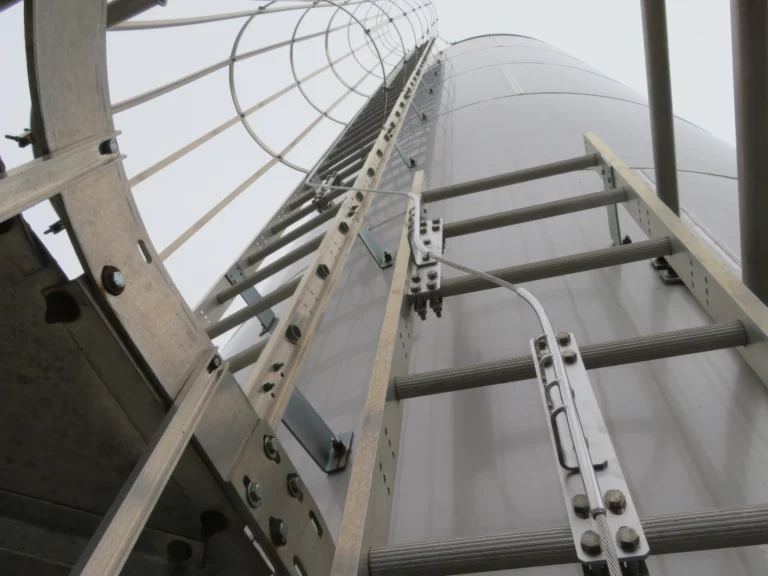
The guide compares the two main options. A ladder safety system costs less, is simpler to use and needs no front D-ring harness, but takes one climber at a time and is not ideal for tall ladders. A vertical lifeline costs more and needs more training, but lets the climber rest, takes two users, spreads load more evenly and suits tall structures such as transmission towers.
What to record before design starts
A survey sheet lists what an engineer needs from each ladder: side-step or walk-through exit, nearest obstructions, rung spacing, rung and stringer size and shape, and whether the system must continue onto an adjacent ladder.
How Tritech handles fixed ladder compliance
Tritech has built fall protection systems since 1993. The work runs as one package: site assessment, engineered design of ladder safety systems, PFAS, guardrails and self-closing swing gates, certified installation, and worker training aligned with 29 CFR 1910.140.
Key specs
| New fixed ladders | Ladder safety system or PFAS required after November 19, 2018 |
|---|---|
| Existing caged fixed ladders | Retrofit with ladder safety system or PFAS by November 18, 2036 |
| Maximum penalty cited | Up to $161,323 per violation |
| Ladder safety system | One user at a time |
| Vertical lifeline system | Two users at a time |
Standards referenced
- OSHA Walking-Working Surfaces standard
- 29 CFR 1910.29
- 29 CFR 1910.140
Questions about this guide
When do caged fixed ladders have to be retrofitted?
According to the guide, existing fixed ladders that rely on cages must be fitted with a ladder safety system or a personal fall arrest system by November 18, 2036. Fixed ladders installed after November 19, 2018 already need one of those systems. Owners with many ladders should survey them early, because design, fabrication and installation all take time to schedule.
Why is OSHA moving away from ladder cages?
A cage was meant to contain a worker who falls, not to arrest the fall. A climber can still drop inside the cage and strike the rungs or the cage itself, so it gives little protection from injury. The rule change reflects current thinking on fall hazards: stop the fall with a system attached to the worker instead of surrounding the climb.
Should I choose a ladder safety system or a vertical lifeline system?
It depends on the ladder and how it is used. The guide lists the ladder safety system as lower cost, simpler to use and not requiring a front D-ring harness, but limited to one user and less suited to tall ladders. A vertical lifeline costs more and needs more training, but allows resting, takes two users and suits tall structures like transmission towers.
What information is needed to design a ladder retrofit?
The survey sheet in the guide asks for the ladder type at the top (side-step or walk-through), the nearest obstructions on the climbing side and behind the ladder, confirmation that rung spacing is uniform, the size and shape of rungs and stringers, and whether an adjacent ladder means the system has to continue onto another section.
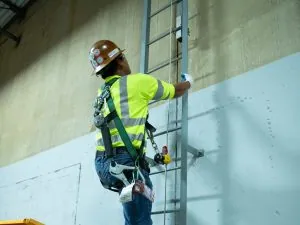
Installed, not just specified
On site with Tritech
1,800+ successful installations in the USA
Downloads
Related downloads
Brochure
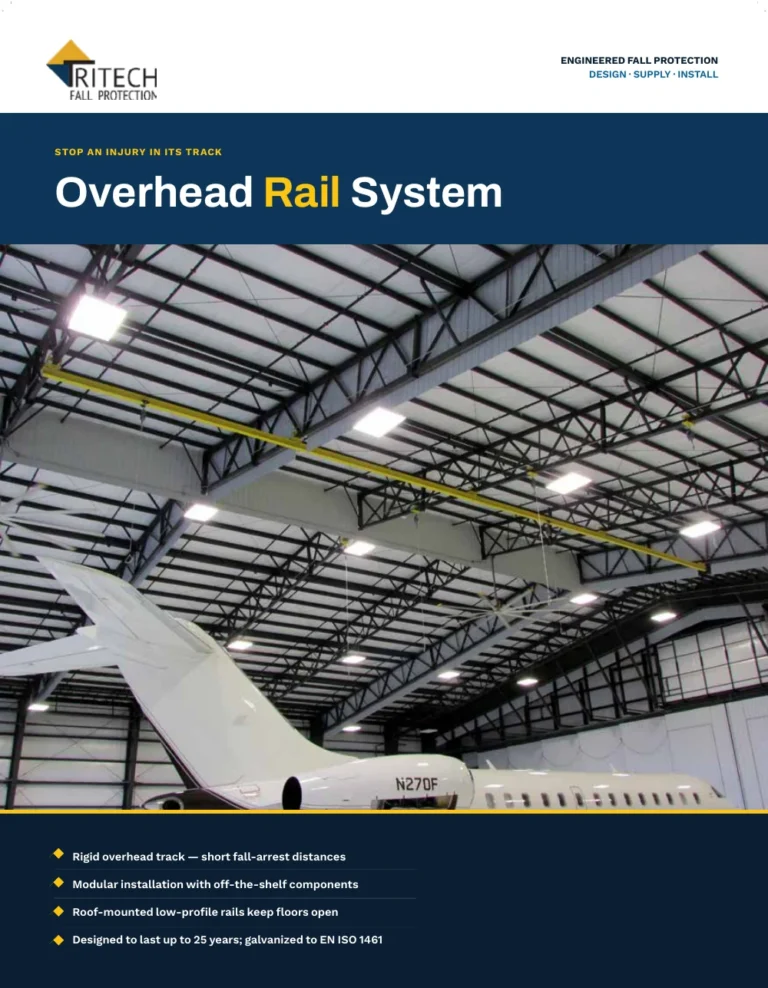
Overhead Rigid Rail System Brochure
Overhead rigid rail fall arrest for hangars, rail and truck loading and plants: short fall distances, open floors and a design life of up to 25 years.

Brochure
Data Center Fall Protection Brochure
How Tritech protects data center roofs and yards: non-penetrating guardrail, access platforms, crossovers, stairs and ladder safety for mechanical equipment.
Have a site in mind?
Tell us about the hazard. We’ll tell you what we’d install, how long it takes and what it costs.